






UNC Health Achieves Significant Savings with Strategic Legacy System Decommissioning Program
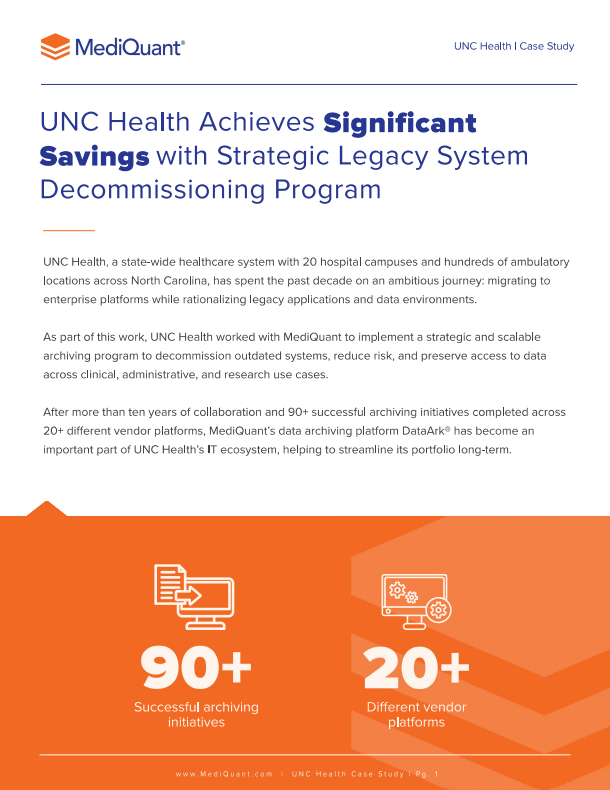
UNC Health worked with MediQuant to simplify its IT landscape by archiving outdated systems and preserving essential data. With 90+ successful initiatives across 20+ vendor platforms, the program reduced risk and supported long-term access to critical information.
"Our goal was to maintain access to legacy data for continuity of care, audit needs, research, and more, while avoiding the overhead of managing all the systems that housed that data. We needed to simplify, reducing operating cost, and minimize risk from having outdated platforms with potential security vulnerabilities." – Matt Castellano, System VP of Enterprise Applications, UNC Health
CHALLENGE:
Reducing IT Complexity Amidst Rapid Growth and Modernization
UNC Health’s data archiving journey began in the early 2010s as the organization prepared to shift from a homegrown EMR to Epic. The timing coincided with new federal Meaningful Use and ICD-10 requirements that made continued investment in proprietary platforms unsustainable.
During this time, UNC Health was expanding its footprint across North Carolina. Through this expansion, they inherited a diverse landscape of legacy platforms that were costly to maintain, often outdated, and highly variable in complexity.
SOLUTION:
A Flexible, Strategic Archiving Provider
UNC Health selected MediQuant and it’s DataArk platform as its enterprise archiving solution. What began with a single project to archive Siemens Invision soon grew into a system-wide initiative spanning 20+ applications including EMRs, patient accounting, ERP, and other clinical and administrative platforms.
One of the main reasons UNC Health chose to work with MediQuant was due to the organization’s proven experience with the specific applications the health system was retiring. Additionally, MediQuant’s flexible, scalable data archival solution and approach addressed a range of use cases - from document repositories to revenue cycle data and complex clinical archives. “We didn’t want users going to five different systems to access their data,” said Castellano. DataArk allowed us to consolidate archives into a single enterprise platform - one interface that works across domains.”.
Results:
Lower Costs, Fewer Systems, Better Security
UNC Health successfully completed over 90 archival initiatives using MediQuant’s DataArk platform, spanning more than 20 different HIT vendor systems, including Allscripts, GE, McKesson, MEDITECH, NextGen, and Siemens/Cerner. This effort resulted in significant cost reductions, improved security by decommissioning outdated platforms with limited patching or visibility, and enhanced operational efficiency for HIM, revenue cycle, and clinical staff, who now access archived data through a single interface. Archiving has become a seamless, low-friction part of UNC Health’s IT lifecycle, enabling smoother operations. Most importantly, MediQuant’s solution supported large-scale application rationalization by reducing complexity, minimizing training needs, and allowing teams to focus on core systems.
Advice for Others:
Ensure vendor has experience with organizations like yours
Castellano offers several takeaways for health systems beginning their archiving journey:
- Start early. Align your archival strategy with your EHR and ERP conversion timelines, especially before contract renewals.
- Tailor your approach. Not every system requires a full-scale archive. Use the right “t-shirt size” based on system type and data access needs.
- Think enterprise. A single archiving platform like DataArk can simplify operations and support scale across departments and locations.
- Plan with the end in mind. The goal isn’t just data storage. It’s strategic decommissioning, user access, security, and cost control.
Contact Us Today
We'd love to hear from you!